
The Farmers Market is not a Venue. It’s a Strategy.
Make the Most of Summer Engagement Opportunities
By Logan Bridge
Farmers markets and street fairs draw crowds, and city and county agencies know it. Booths from public agencies are a regular fixture at events through the summer months, and for good reason. People are already gathered in an activated public space, and more open to a spontaneous conversation than they might be on a typical evening after work.
The challenge is that you're often competing for attention with local produce, artisanal crafts, food trucks, and live music — everything that makes these events worth attending in the first place. It's genuinely easy for people to avoid eye contact with a public outreach booth, and many of them will. Showing up is the easy part. Getting people to stop, engage, and share something useful takes more thought than a folding table and a tent. If we want to build trust, our presence must be as welcoming and intentional as the community events themselves.
A few things that make a real difference:
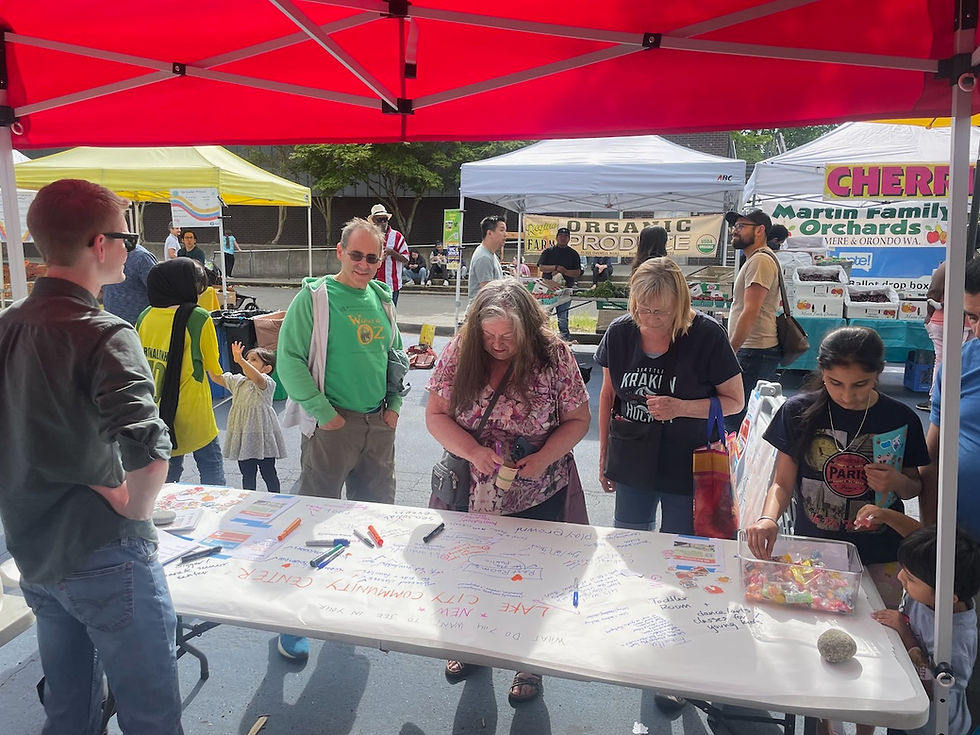
Invite participation, not just observation. The booths that generate the most meaningful input tend to be the ones where attendees participate in something active. For the Lake City Community Center needs assessment, we partnered with Seattle Parks and Recreation staff to bring the assessment directly to a series of neighborhood farmers markets and community events. Parks staff ran outdoor games and craft activities—the kind of programming community centers are built around—which drew families in and signaled that the center is a place for joy and connection. In tandem, BvP staff facilitated an interactive word game where people of all ages could write or draw what they hoped for in the future space.
What struck us was how naturally our conversations unfolded. Kids who came over for the activities ended up contributing ideas. Parents who stopped to watch did too. People who hadn't planned to engage with any booth that day found themselves thinking seriously about what their community center could and should be. That kind of input can be hard to generate through a survey or a public meeting; it happens when people are already doing something enjoyable.
Design materials that serve the public. At a busy outdoor event, many[C1] people will pick something up without stopping to talk, and that's worth preparing for. The materials you hand out are part of the engagement, not a last resort for the people who didn't stop to chat.
For our flood risk communication and outreach work across Snohomish County, we staffed a flood readiness booth at farmers markets and community events across the county. Materials included an eye-catching flood preparedness brochure with genuine utility – it included a checklist for assembling an emergency kit, as well as clear, practical guidance on what to do before, during, and after a flooding event. People took it because it was useful to them, not just to end the conversation and move to the next booth. We paired the brochure with fun, custom-designed[C2] stickers, and watching people stick them on their water bottles right there at the booth was a tangible sign that the community was taking the message home with them. We also had educational activities for kids about local rivers and key safety terms, which gave families with children a reason to linger and learn more.
None of those details are incidental. The sticker that ends up on a water bottle extends our presence beyond the booth. The emergency preparedness brochure that gets stuck to the fridge is a key safety resource. Thinking carefully about what you put in people's hands is part of thinking carefully about the message of care you are sending.
Signal your purpose from a distance. At an event with dozens of booths, many people decide about whether to approach before they're close enough to read anything in detail. First impressions at these events are largely visual, and they happen fast, particularly when there's so much other excitement going on.
The flood readiness booth sent a clear message through this noise. Large bilingual signs in English and Spanish announced the flood preparedness focus clearly, so people understood what the booth was about from across the aisle. A large, printed floodplain map gave people an immediate and personal reason to stop. Many wanted to find their own neighborhood on it, and the ones who did were already invested in the conversation because the space felt relevant to their daily lives.
That combination—clear purpose, language access, and something visually compelling and directly connected to people's lives—is what turns a booth people might walk past into one they actively seek out.
Farmers markets and street fairs offer some of the best organic opportunities for community engagement available during the year. But the real opportunity isn't just access to a crowd — it's the chance to reframe what outreach looks like. When the public experiences something enjoyable, gets something useful, or sees themselves reflected in outreach process, the dynamic shifts. You're no longer asking people to give their time to your process. You're offering something in return. That exchange is what builds the trust that makes the input you collect actually worth having.


Comments